The Year End Carryover report provides information on funds that are unobligated at the federal fiscal year end. This report only takes into account awards that have been obligated as of the report date. A calculation is performed to determine the age of the funds that are unobligated by grant program and subprogram. Based on this calculation unobligated funds are transferred according to the following: (1) Carryover, (2) Reversion Adjustment, or (3) Reversion.
"Carryover" means the unobligated funds will be returned to the State to the same grant program/subprogram.
"Reversion Adjustment" means the unobligated funds exceeded the period of authority/availability at the subprogram level but not at the grant program level also called the “parent” or “rollup” account. The funds are returned to the State at the parent account.
"Reversion" means the unobligated funds exceeded the period of authority/availability for grant program. The reverted funds are returned to the Service in accordance with the Pittman-Robertson Wildlife Restoration or Dingell-Johnson Sport Fish Restoration Acts, and State Wildlife Grant Program.
The report is available for download as an Excel spreadsheet.
- What is the purpose of the Year End Carryover Report?
This report exhibits unobligated fund balances for the Wildlife Restoration (WR), Sport Fish Restoration (SFR), State Wildlife Grants (SWG) grant programs and subprograms administered by the Service. Recipients have two years to obligate the apportioned funds from these grant programs, with the exception of the Enhanced Hunter Education (Section 10), which has only one year of funding availability and Boating Access (part of SFR) which has a five year funding availability. The purpose of the Year End Carryover Report is three-fold:
- Calculate and display grant program funds by recipient that have a subsequent year to be obligated and that will carry-over to the next Federal Fiscal Year even if not obligated in the current Federal Fiscal Year;
- Identify grant program funds that will revert if NOT obligated by the end of the current Federal Fiscal Year; and
- Identify “reversion adjustment” amounts that will exceed the period of availability at the "child" account or subprogram level but will carry-over to the next Federal Fiscal Year to the “grant program (often called parent account)” level. See the FBMS Definitions and Acronyms for a list of grant program "parent" and "child" or "subprogram" accounts.
- How can I use the Year End Carryover Report?
The Year End Carryover Report SHOULD be used as a budget planning tool by the State to identify grant program funds that will revert if NOT obligated by the end of current Federal Fiscal Year. The report is especially useful once the “final” apportionments for WR, SFR, and SWG programs have been entered into the FBMS accounting system, The reports are also useful to monitor towards the end of the Federal Fiscal Year to ensure applications are submitted in time to be approved and obligated before year end deadlines. Remember that the report is a “static” report as of the run date and numbers in the report will change as grant program funds are obligated in the Service’s financial accounting system, the Financial and Business Management System (FBMS). - What information is contained in the Year End Carryover Report?
The Year End Carryover Report exhibits unobligated fund balance amounts by grant program that will either carryover or revert or be transferred to the parent grant program based on grant obligations made to date during the current Federal Fiscal Year. - How is the Year End Carryover Report organized?
The Carryover Report is organized by State and by grant program, displaying the unobligated balance between calculated carryover, reversion and reversion adjustment amounts based on obligations made to date in the current Federal Fiscal Year. - What do the various column headings in the Year End Carryover Report mean?
- Fiscal Year – This column contains the four-digit Federal Fiscal Year selected by the user. Typically, user will select the most current Federal Fiscal Year and the most current Month to get the most up-to-date status to determine if grant program funds will carry-over to the next Federal Fiscal Year or will revert (i.e. be lost to recipient) and return to the Service for other uses consistent with the PR-WR and DJ-SFR Acts, or re-apportionment to all States under the SWG Program. The Federal Fiscal Year (FFY) is the financial period sometimes referred to as a budget year, is a period used for calculating annual financial statements. The Federal Fiscal Year is October 1 through September 30.
- +/- – A plus (+) sign associated with the Text “Carryover” column indicates the funds shown in the line will carry-over to the grant program (e.g. 5221 Section 4 Hunter Education) in the next Federal Fiscal Year even if the funds are not obligated before the end of the current Federal Fiscal Year. A negative (-) sign associated with the Text “Reversion” indicates the funds shown in the line will revert to the Service if NOT obligated before the end of the current Federal Fiscal Year. “Reversion Adjustments” in the Text Column will have offsetting plus (+) and negative (-) lines. “Reversion Adjustments” result from the age of the funds exceeding the period of availability at the "child" account or subprogram level but are within the period of availability within the grant program or "parent account." These funds will carry-over to the next Federal Fiscal Year to the parent “grant program.) For “Reversion Adjustments,” the negative (-) sign indicates the subprogram (e.g. 5221) the funds will be transferred from the "child" account whereas the plus (+) sign amount is the transfer to the parent grant program (e.g. 5220 (sum of 5221 and 5222)) . Determining whether funds revert in accordance with the two-year or five-year availability/obligation rule is done at the grant program (parent) accounting level, not the subprogram (child) accounting level. The “Reversion Adjustments” will carry-over to the next Federal Fiscal Year at the grant program (e.g. 5220) parent level, and then will be transferred back to the pertinent sub-program (e.g. 5221) child level at the start of the new Federal Fiscal Year if needed.
- State – This is the Funds Center used in the Service’s FBMS financial system to represent an organizational element where budgets are assigned and executed. The Service has setup a unique Funds Center for each State. For example, the Funds Center for Minnesota is FF03M020MN. For recipient usability purposes, identify your State’s two-digit abbreviation (e.g. MN), which are the last two digits of the Funds Center, and then filter the column to identify the lines pertaining your State.
- Grant Program – The Grant Program is an alpha-numeric number used in the Service’s FBMS financial system to distribute and track budgets at grant program and subprogram levels. Recipients should ignore all digits except for the fourth through seventh digits, which will identify the grant program or subprogram. The four digit number represents the grant program for the applicable WR, SFR, or SWG program. For example, the Grant Program number FWF562400.000000 equates to subprogram 5624 (SWG Implementation 65% Federal Share).
- Budget Amt – The Budget Amount represents unobligated funds in the Service’s accounting system for each grant program/subprogram for each State as of the refreshed date on the report.
- Text – (1) Carryover – indicates the Budget Amount shown has a subsequent year to be obligated and will carry-over to the next Federal Fiscal Year even if not obligated in the current Federal Fiscal Year; (2) Reversion – indicates the Budget Amount shown does NOT have a second year to be obligated and the amount will revert to the Service if not obligated by the end of the current Federal Fiscal Year; (3)Reversion Adjustment - As explained in the (-/+) column description above, Reversion Adjustments relate to the mechanics of grant program/subprogram (parent/child) level accounting to determine if funds are obligated within the funding availability. “Reversion Adjustments” are difficult to explain in words, so we have included an example below that might help with understanding these adjustments:
- FWS Yr End
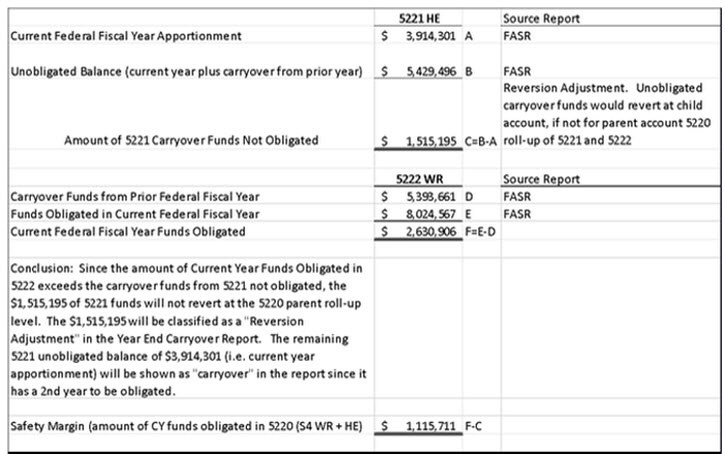
- What grant/financial data is included or excluded from the Year End Carryover Report?
The Year End Carryover Report includes financial data from the Department of Interior's Federal financial system, the Financial and Business Management System (FBMS) for the current Federal Fiscal Year. The Federal Fiscal Year is from October 1st through September 30th. The financial data changes as transactions are entered into FBMS on a daily basis. The report contains the financial transactions as of the report refreshed date.- The Year End Carryover Report reflects the estimated amounts that would be carried over, adjusted or reverted as if it were year-end. These amounts will change as grants are obligated and de-obligated throughout the year. Transfer of funds between grant programs also impact the funds be carried over, adjusted or reverted.
- Apportionments, transfers, grants and modifications entered into FBMS as of the report date are included in the report.
- Apportionments are typically entered in FBMS when the preliminary apportionment or final apportionment letter is sent to the States.
- Transfers between grant programs are performed by the Regional Offices after apportionment of funds or as requested by the State. All requested transfers must meet PR-WR and DJ-SFR laws and regulations, and SWG program rules.
- Obligation of funds occurs after grant applications and/or modifications are reviewed, approved by the Regional WSFR Chief, and entered into FBMS.
- De-obligation of funds occurs after: 1) grant applications and/or modifications decreasing grant funds are reviewed, approved by the Regional WSFR Chief, and processed in FBMS; and 2) a Final Federal Financial Report (SF-425) is reviewed, approved, and a de-obligation of unused funds is processed in FBMS.
- Check with the Regional Office to determine pending actions.
- Example: As obligations are made throughout the current Federal Fiscal Year, the figures in the Year End Carryover report will change. For example, if during the current Federal Fiscal Year, the report exhibits in May XXXX that $1,000,000 of subprogram 9514 (Freshwater Sport Fish Restoration) are classified as “Reversion,” and in June XXXX, $1,000,000 of 9514 subprogram funds are obligated to grants by the Regional Office, the “Reversion” will disappear from the Year End Carryover Report after the funds are obligated.
- How frequently is the Year End Carryover Report updated?
The Year End Carryover Report data is refreshed on approximately the 1st of each month. The report is uploaded to TRACS within the next three business days. - What if I need a Year End Carryover Report before the 1st of the month?
If there is an urgent or special need to obtain an updated Year End Carryover Report between the mid-month posting dates, contact your Regional WSFR Financial Specialist for assistance. - How long are the monthly Year End Carryover Reports available in TRACS?
All Year End Carryover reports beginning with August 15, 2014 will remain available in TRACS indefinitely.